
Well and domestic water system – components
Well and domestic water system – components
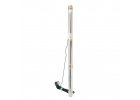
If the well is shallow, the domestic water system draws water through a hose with a suction strainer at its end; for deep wells and boreholes, a submersible pump is chosen. Constant pressure in the water supply is maintained by a pressure vessel together with a pressure switch. Click a number to open the matching product.
A number in the diagram takes you to the matching item in the list below.
Step 1: drawing water from the well



Step 2: pressure station
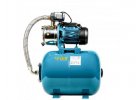
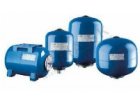

Step 3: filtration and water distribution
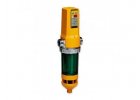
Water supply from a well or borehole
A domestic water system provides pressurised water for a house, a cottage or a garden wherever there is no public water mains or where the customer wants to save mains drinking water. The set helps heating engineers and resellers choose the right type of pump according to the depth of the water level, add the suction or delivery line and set up the pressure switching. The overview covers both shallow wells and deep boreholes.
Installation procedure
- Find out the depth of the water level during pumping, the depth of the well, its yield and its distance from the house. These figures determine whether a domestic water system with a self-priming pump is sufficient or whether a submersible pump is needed.
- For a shallow well, prepare a suction pipe or a rigid-walled hose. Fit a suction strainer with a non-return valve on the end so that it is below the lowest water level and at the same time sufficiently above the bottom.
- Run the suction pipe to the pump with a constant upward gradient, without any points where air could be trapped. All joints on the suction side must be airtight.
- For a deep well or borehole, suspend the submersible pump on a stainless steel cable, not on the power cable or the pipe. Install a non-return valve in the delivery pipe, and extend the cable only with a watertight connector.
- Place the domestic water system or pressure vessel on a firm base in a dry, frost-free room.
- Connect the pressure switch with the pressure gauge at the pressure vessel. Install the filter, shut-off valves and the distribution pipework to the house after the vessel.
- Entrust the electrical connection, including residual current device protection and dry-run protection, to an electrician.
- Before the first start-up, prime both the suction pump and the suction pipe with water.
Choosing the right parts
- Suction lift. In theory, a pump can draw water from a depth of approximately 10 m; in practice, with losses, usually only around 7 to 8 m, and even less with a long horizontal pipe. If the water level is deeper, go for a submersible pump.
- The flow rate should be chosen according to the outlets used simultaneously, but also according to the yield of the source – the pump must not empty the well faster than it refills.
- The delivery head is the sum of the height difference from the water level to the highest outlet, the pressure required at the outlet and the losses in the pipework.
- Pressure vessel. A larger vessel means fewer pump starts and a longer service life. The air pre-charge is set slightly below the cut-in pressure of the switch, measured with the water drained.
- The submersible pump must pass safely through the borehole casing together with the cable and the suspension rope. Choose the cable cross-section according to its length and the power input of the pump.
Most common installation mistakes
- A soft-walled suction hose that collapses during suction.
- A leaking joint on the suction side – the pump draws in air and cannot prime.
- A suction strainer lying on the bottom of the well, from where it draws in sludge and sand.
- A submersible pump suspended on its cable.
- Incorrect pre-charge of the pressure vessel, so the pump switches on unnecessarily often.
- A domestic water system in a room without frost protection.
Commissioning and maintenance
After priming, start the pump with an outlet open, let it expel the air and then close the outlet. Check the pressures at which the switch turns the pump off and on, and readjust it according to the instructions if necessary. Once a year, check the vessel pre-charge, replace the filter cartridges and, before winter, make sure that any parts that could freeze are drained.
Frequently asked questions
Can well water be drunk?
Only if a laboratory analysis confirms that it is safe. A filter removes mechanical impurities but does not replace a hygiene assessment of the water.
Why does the domestic water system switch on every time a tap is opened?
The most common cause is an incorrect pre-charge or a damaged membrane in the pressure vessel, or a leak in the pipework.
When should a submersible pump be used instead of a domestic water system?
When the water level is deeper than the pump of a domestic water system can reliably draw from, or in a small-diameter borehole.
Is a domestic water system also suitable for a rainwater tank?
Yes. In that case, water is drawn from the tank through a suction pipe with a strainer or through a floating suction filter that takes cleaner water from just below the surface.
What to order for the domestic water system
Put the set together from the Domestic water systems or Submersible water pumps range; for the suction side, add the Suction strainer - with non-return valve - 1"F, and for switching, the PC-2 pressure switch with pressure gauge. Registered partners can see wholesale prices after logging in. We dispatch goods from our warehouse in Žilina and ship them throughout the EU.