
Fitting an underfloor heating manifold – procedure
Fitting an underfloor heating manifold – procedure
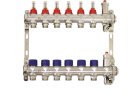
The manifold delivers heating water to the individual underfloor circuits. Add ball valves with thermometers, a cabinet, control actuators and eurocone fittings for each circuit. Click a number to open the matching product.
A number in the diagram takes you to the matching item in the list below.
Step 1: manifold and ball valves


Step 2: connecting the loops


Step 3: circuit control


Step 4: fitting into the cabinet

The underfloor heating manifold in practice
The manifold is where underfloor heating is adjusted, controlled and serviced. The set is intended for installation companies and heating engineers who need to equip a manifold completely – from the shut-off valves and circuit connections to the electrothermal actuators and the cabinet. A correctly chosen and balanced manifold determines whether all the rooms will be heated evenly.
Installation procedure
- Set the flush-mounted cabinet into the wall when the partition walls are being built. Choose the height so that the pipe can be bent from the manifold into the floor without kinking, taking into account the thickness of the floor layers.
- Fix the manifold on the brackets in the cabinet. Fit the flow bar and the return bar according to the manufacturer's marking – one carries the flow meters, the other the valve inserts for the actuators.
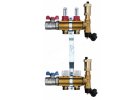
- Fit ball valves with thermometers on the inlets – the valve with the red handle on the flow, the one with the blue handle on the return.
- Fit automatic air vents and drain cocks for filling and flushing on the ends of the bars.
- Connect the circuits one by one: the start of the circuit to the flow bar, the end to the return bar. Calibrate each pipe end and connect it with a eurocone fitting.
- Label the room and the circuit length at each outlet – you will need this information for balancing.
- Flush each circuit separately, bleed it and carry out a pressure test of the whole assembly.
- Fit electrothermal actuators on the valve inserts of the return bar and connect them to the wiring centre or directly to the room thermostats.
Choosing the right parts
- The number of outlets corresponds to the number of circuits. With a large number of circuits or long distances, it is better to split the house between two manifolds so that the supply sections are not too long.
- Manifold material. Stainless steel manifolds are light and corrosion-resistant; brass manifolds are more solid and offer a wide choice of accessories. For both, check the maximum flow rate and the connection dimensions.
- Electrothermal actuators should be chosen according to the voltage of the control unit or thermostats: 230 V is connected directly, while 24 V requires a transformer but is safer for cable routing. Also check the connection thread of the insert and whether the actuator should be normally closed or normally open.
- A thermostat with a floor sensor is suitable for bathrooms and rooms with tiles or wooden floors, where the floor surface temperature needs to be limited.
- The cabinet must be wide enough for the manifold, the ball valves, any mixing unit and the pipe bends; choose the depth according to the wall thickness.
Most common installation mistakes
- Start and end of a circuit swapped – the flow meters and actuators then do not work correctly.
- An uncalibrated pipe or a damaged eurocone O-ring.
- Unlabelled circuits that cannot later be assigned to rooms.
- Flow meters left in the same position regardless of the length and demand of the circuits.
- An actuator voltage that does not match the thermostats or the control unit.
- A cabinet that is too narrow, in which the pipe kinks in tight bends.
Commissioning and maintenance
After flushing and the pressure test, set the flow meters according to the calculation – longer and more heavily loaded circuits need a higher flow rate. Check the operation of the actuators by switching on the thermostats; an electrothermal actuator opens and closes gradually, over a matter of minutes. During the annual check, inspect the joints for leaks, the operation of the air vents and the cleanliness of the flow meter sight glasses.
Frequently asked questions
Why does each circuit need two compression fittings?
A circuit starts at the flow bar and ends at the return bar. One fitting goes on each end of the pipe.
Should I choose 230 V or 24 V actuators?
The control system is decisive. For a simple connection to 230 V thermostats, mains voltage is more practical; for more extensive control systems and in damp rooms, 24 V is often preferred.
How long does it take for the actuator to open the circuit?
An electrothermal actuator works by heating a working medium, so it responds more slowly. With underfloor heating, which is itself a slow system, this does not matter.
Is a mixing unit needed at the manifold?
Yes, if the heat source supplies water at a higher temperature than the underfloor heating can tolerate. With low-temperature heat sources, it can sometimes be omitted – the design is decisive.
What to order for the manifold
The basis is formed by underfloor heating manifolds; for connecting the circuits, the Compression fitting 16 x 2 EK for PEX-AL-PEX pipe; for control, the Electrothermal actuator 230V; and for housing, the Manifold cabinet 335 mm - flush-mounted. Registered partners can see wholesale prices after logging in. We dispatch goods from our warehouse in Žilina and ship them throughout the EU.